
What is dot notation?
Dot notation is a way to access specific properties of an object or array using a period (.) to separate the property name from the object or array.
Using dot notation with objects
Let’s say we have the following object:
{
"name": "John",
"age": 30,
"created_at": 1736364473744
}
If we want to use an Update Variable function to update that created_at property to be human readable, we would use dot notation to target that property directly, like this:
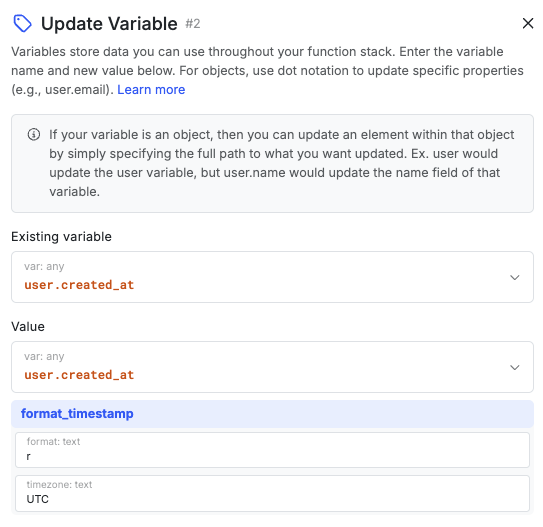
This will target created_at inside of the object and update it to Wed, 08 Jan 2025 19:27:53 +0000.
You can also use dot notation to create new properties inside of an object. Our user object doesn’t have a location property yet, so we can add it like this:
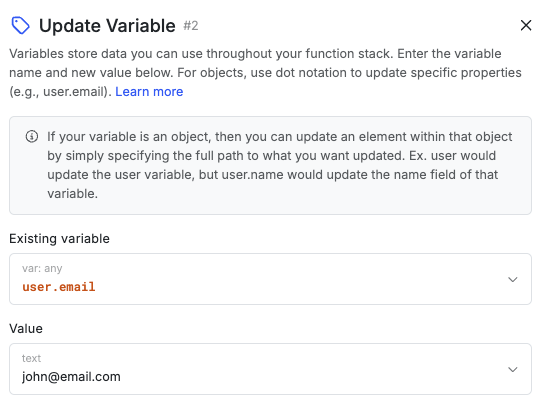
So, even though the email property doesn’t exist, using dot notation to target it will create it for us.
Using dot notation with arrays
Arrays are a little different than objects in that they are indexed, starting at 0. So, the first item in the array is at index 0, the second item is at index 1, and so on. The index just refers to the position of the item in the array.
Let’s say we have the following array:
[
"apple", // index 0
"banana", // index 1
"cherry" // index 2
]
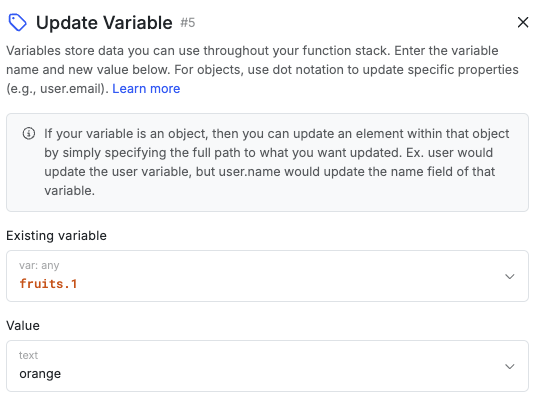
If we want to use an Update Variable function to update the second item in the array to be “orange”, we would use dot notation to target that item directly, like this:
This will target the second item in the array and update it to orange.
Using dot notation with complex nested data
You can use dot notation with any combination of nested arrays and objects.
Let’s say we have the following array:
[
{
"name": "apple",
"details": {
"color": "red",
"price": 1.00
}
},
{
"name": "banana",
"details": {
"color": "yellow",
"price": 0.50
}
}
]
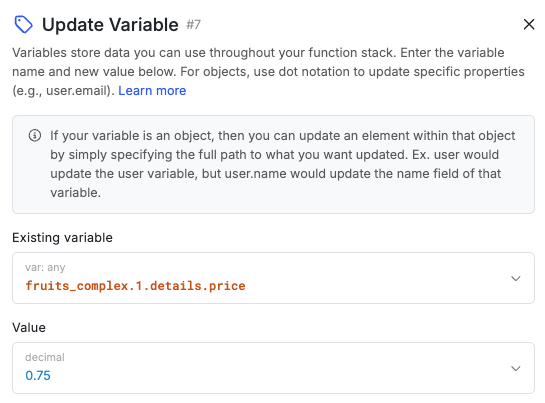
If we want to use an Update Variable function to update the price of the second item in the array to be $0.75, we would use dot notation to target that item directly, like this:
This will target the second item in the array and update the price to $0.75.
When you need to utilize dots inside of keys (for example, if an external API is returning a key with a dot in it), use double dots to ‘escape’ the dot and it will remain, instead of being interpreted as dot notation. For example, to access a key named user.name, you would use user..name in your dot notation. Without the double dots, it would try to access the name property of the user object.
Try it out
You can create a new API or custom function and paste the following XanoScript into the editor to see it in action. Feel free to experiment and modify the logic to get a feel for how it works.
query dot_notation_example verb=GET {
input {
}
stack {
var $user {
value = {}
|set:"name":"John"
|set:"age":30
|set:"created_at":1736364473744
}
var.update $user.created_at {
value = $user.created_at|format_timestamp:"r":"UTC"
}
var.update $user.email {
value = "[email protected]"
}
var $fruits {
value = []
|push:"apple"
|push:"banana"
|push:"cherry"
}
var.update $fruits.1 {
value = "orange"
}
var $fruits_complex {
value = """
[
{
"name": "apple",
"details": {
"color": "red",
"price": 1
}
},
{
"name": "banana",
"details": {
"color": "yellow",
"price": 0.5
}
}
]
"""|json_decode
}
var.update $fruits_complex.1.details.price {
value = 0.75
}
}
response {
value = {
user : $user
fruits : $fruits
fruits_complex: $fruits_complex
}
}
history = {inherit: true}
}